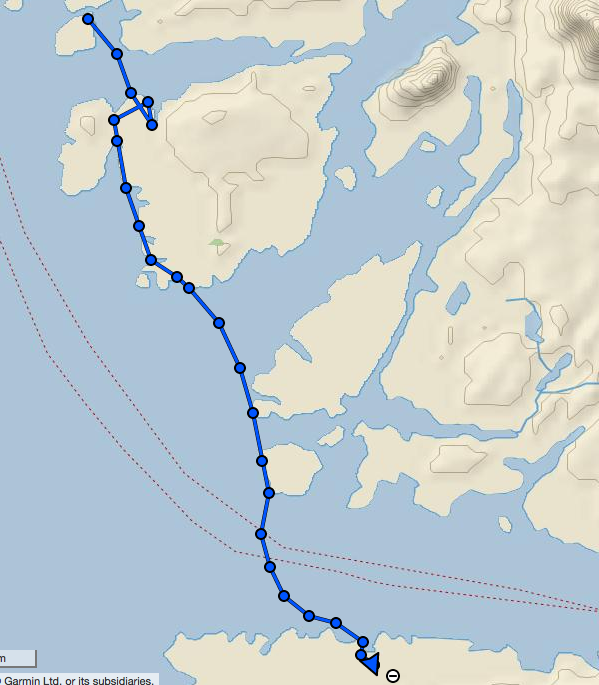
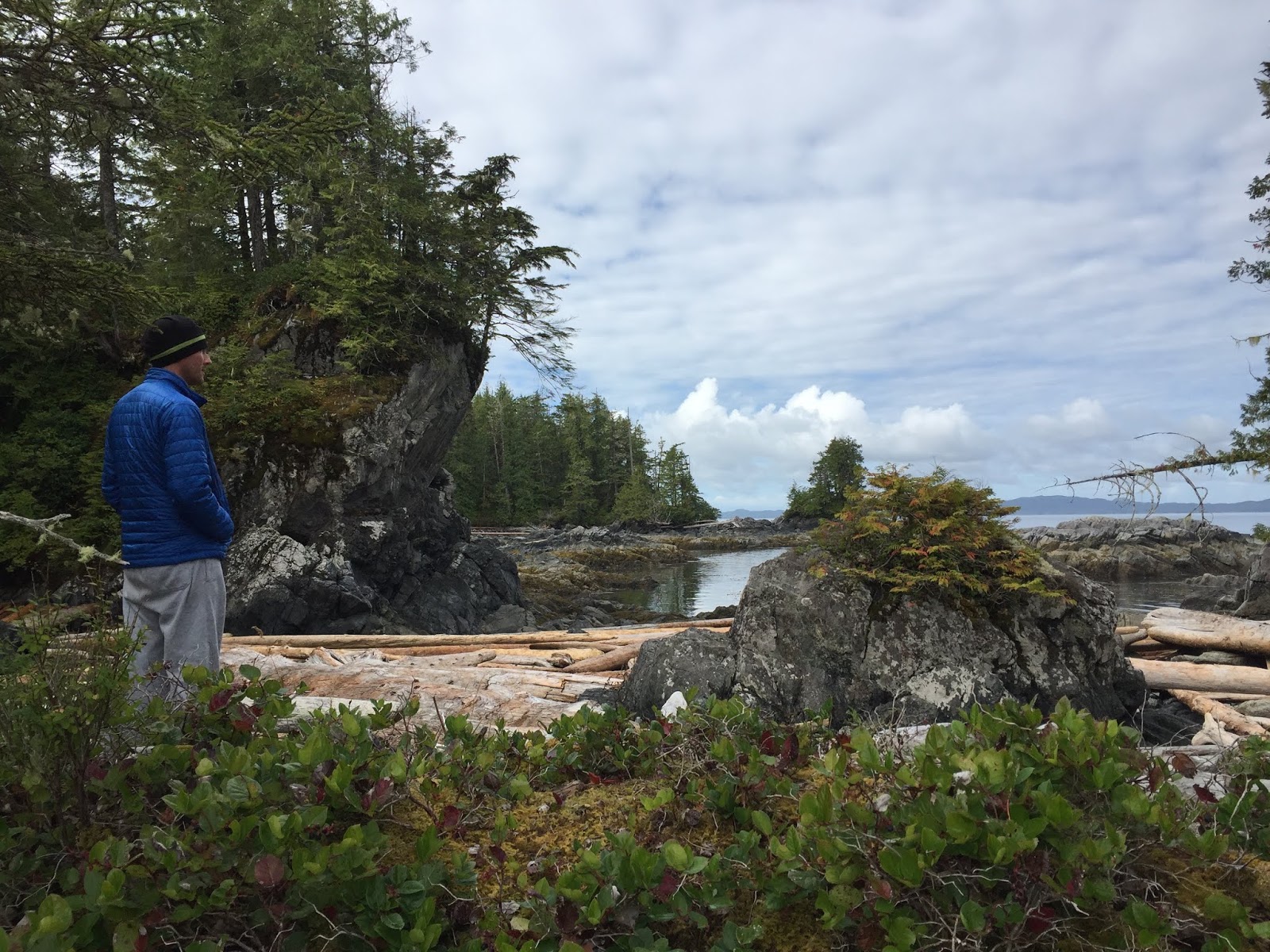
Tremendous wind and crashing waves all night. Woke to heavy wind and rain, and decided we wouldn't lose anything by going back to sleep, because — fuck this shit. Coffee and late breakfast under the tarp over the kitchen area. The only game available was something we called "attack points" — gathering the water that ran off the tarp in bucketfuls, betting on the location of the next dump by placing a pot under it. You won if the water chose your pot to land in; you lost if it dumped on the ground next to you and splattered you with wet sand.
We found out we'd had a very close shave last night. Yesterday the pile of kindling we'd first seen the day before was still there, so with our kayaks up at the height of the fire pit we didn't think it was necessary to tie them up. But this morning the kindling was gone and there was tide foam on the hulls of our boats — we'd almost lost them! What a difference 0.2m of tide can make. Remember, kids, always tie up your kayaks, no matter how silly it may seem.
At a number of points the wind got right up under our tarp and threatened to blow it away. The tarp was providing exactly no protection from the elements at this point, and there wasn't a lot of charm to be found in the prospect of sitting out in this shit all day. Weather forecast for Queen Charlotte Sound were winds 25-35kt and seas 3-5m. Suddenly the cabin at Quinoot Point seemed like a very attractive destination, a place where we could sit out the worst of it, dry our soaked gear, and hit "reset."
When the rain let up a bit,we struck camp and lit out up Louise Channel again — it was becoming a very familiar paddle. But reliable Louise, she never gives us any trouble; it was a calm and windless journey to Boddy Narrows, where we caught a bit of a southerly that pushed us the rest of the way to Quinoot Point. Since it wasn't raining on us, we nosed around the "back door" of Quinoot into upper Thompson Bay, which was as flat as an Ontario lake, complete with loons. Jonathon rode the currents through the "back door" a few times just for kicks.
Back at Quinoot Cabin we pulled the yaks way up into a tent spot and lashed them to a tree for good measure. It took a lot to get any heat generated in the cabin, and while the fire was gathering we collected driftwood and put it under the cabin to dry for the next visitors. Eventually we got some heat going, and our wet gear began to off-gas, a pungent guys-and-brine aroma that assaulted us anew every time we exited and re-entered the cabin. If we'd been clever, we'd have washed our paddling gear before hanging it to dry, but nobody accuses us of being anything besides daft.
We settled in for an afternoon of reading and tending the fire. Everything took ages to dry, but a lot less time than it would have taken out there in the elements; we were pelted with intermittent downpours and squalls that made us very grateful for the Heiltsuk's generosity in sharing these cabins with visitors. I felt like I must do better next year — that I had possibly let Jonathon down by being so cautious, avoidant of bigger water and currents, overly cautious. I wasn't feeling terribly confident in my kayak; it didn't fit me as well as I'd like, nor did the low primary stability give me the feeling I could tackle as much as he could. And I wasn't very well conditioned heading into the trip. Must make more of an effort to keep fit over the winter this year.*
The forecast from now to Wednesday was for progressively less wind and rain, so we thought the Serpent Group was still a good potential target. It seemed impossible that only yesterday morning we woke up on McMullin — there had been so many episodes since then! The epic flight from McMullin to 48; drying our tent in the sun; the first paddle to Quinoot and sunbathing; fighting the wind on the way back to 48; playing attack points under the tarp for dinner; then double-rainbow-krummholz-eagle; waking this morning to black skies and gloom; more breakfast attack points; then a lovely paddle to Quinoot and the back door; now killing time in the cabin while the sky pounded down buckets.
The wind kicked up at bedtime, and the rain continued all night. The trees outside the cabin sounded like monsters trying to claw their way in. Luckily I had Spider-man to protect me, as he no doubt has protected many a Heiltsuk youth.
Pissing rain all night. Now we know what those high ripply clouds meant: weather changing for the worse. Yesterday was the calm before the storm. There was a stiff breeze blowing from the south, and as we packed up our gear, disorganized and dishevelled and wet, I checked the forecast on the marine VHF. It was not looking good: multiple fronts coming in from the west, and gale force winds predicted. We agreed Goose was a bad prospect at this time. We decided to beat a retreat for Islet 48 and assess our options from there; an updated forecast was due in a couple of hours.
The ride back north from McMullin was a little hairy: following to beam-on sea and wind, causing significant weathercocking and much zig-zagging on our route, but which carried us along at a clip despite the confused water and challenging conditions.
Back at 48 we decided we'd stay there tonight and then head south tomorrow through calmer protected channels. The sun came out so we took the chance to dry the tent and gear out before setting it up. We ate lunch and marvelled at how calm it was to the north and east of us, while out in Queens Sound the wind and water was raging.
We'll be spending a bit of time between these two points
We took a jaunt up Louise Channel, a pretty little waterway where we found conditions calm and mild. There was lots of active wildlife: kingfishers, ravens, eagles, herons, and a mama and baby otter.
Louise Channel
We were paddling against the current, but it was nothing significant. We topped up our water supply at an excellent source not far up Louise
Channel from our camp, and continued in nearly ideal conditions all the
way to Quinoot Point.
Quinoot was sunny and warm, and there was nary a breath of wind. The Heiltsuk cabin here was by far the nicest one we'd encountered. It was tidy and well-kept.
The outhouse here was a bit dicey, but something beats nothing. Weird blond slugs and big droopy gobs of moss abound.
After a bit of an afternoon tramp and laze in the sun, Jonathon thought a shirt-off paddle back to 48 was in order, but then clouds over Joassa Channel said otherwise. Out of the protection of the little bay at Quinoot Point, we encountered a strong headwind, which thankfully lessened once inside Louise Channel again. I finally felt like I was getting the hang of my forward stroke — I felt like I nailed all necessary aspects of it a few times.
As we hit camp it started to rain. We set up the tarp, and the weather retaliated. Chaos and soaking driving rain. The tarp collected gallons of water, then dumped them on the ground, splashing sand everywhere. Rinse, repeat.
We are not amused.
Then, a reprieve. The sun returned, and with it a double rainbow with eagle and krummholz tableau.
Out in Queens Sound the seas were still raging. It's amazing how the islands and the kelp absorb the wave energy so that the back channels aren't turbulent at all. The forecast was for rising wind and building seas for the next 24-48 hours and no real respite til Tuesday (it was currently Friday). We thought we might try to take Louise channel to south Joassa channel and wind our way south behind the protection of the Tribal Group... but it'll be a judgement call.
McMullin to Quinoot and back to Islet 48, Sept 7, 2018: 24 km
There was no particular rush this morning. High slack was around 10:30. From reading Jon Dawkins' excellent blog I should have known that the time to transit the Gale Passage rapids was 2 hours before slack,new info indicates maybe 1 hour after slack, but somehow I had missed this bit of wisdom in my research. We awoke at 7:00 to a forest alive with activity: things dropping out of the trees sounding very like footfalls, twittering birds, ravens, gulls, and who knows what all else — bonobos? — it was comical how much chattering and clattering there was.
We filled up our water jugs and did a bit of light laundry in the repugnant tidal estuary before setting out around 9:30.
The mouth of the northern Gale Passage rapids
A very quick jaunt brought us to the rapids, where we circled and floated and tested the waters nervously.
Contemplating the next move
Jonathon, a veteran of many canoe trips, plotted a line through the first set of rapids avoiding an obvious rock and sweeper — we ran to the west side through the V of the current and it was clear sailing. Quickly scoping the second set of rapids, we avoided the overfall to the east and again took a western line through the V, which brought us to a wide, dead-flat lagoon. From here we had two options: to the east was a shallow and maybe impassable channel, or we could hit the south rapids. We decided to head east and check out the less rapid option.
Paddling with the man in the mirror
The lagoon got shallower and shallower til at last we were at the turning point. Two more little rapids were filling up this lagoon, and we'd be paddling against the current here. There was hardly enough water to get your paddle blade in. We considered a wade-and-drag, but instead opted to try to bash our way through on an upstream run. There were a couple of dicey moments where I thought I was going to get sent backwards and/or sideways, which would have meant an uncomfortable dunk and maybe a bruise or two, but panic and power prevailed and like spawning salmon we flopped our way upstream. Once through, the rest of the passage was eerily calm and beautiful. We could hear the second set of rapids, but didn't see them.
Out into Thompson Bay, we decided to check out the campsite at Cree Point and have a bite to eat. After a short paddle, we rounded the corner into a very protected little bay. Like at Dallas Island, the site was marked with a float. Behind a driftwood windbreak, there was one little-used tent site in a bed of soft moss, surrounded by salal.
We paddled down the shoreline of Potts Island to the Islet 48 site, which we'd heard spoken highly of. It had tons of "featurettes" including tropical sand,
a fire pit,
a driftwood kitchen,
a pit toilet made of an old float,
and even a shower! Too bad it didn't have water in it, or we'd have taken advantage.
A sign said "Respect Heiltsuk territory", and another said "SIMON". The fire pit was stocked with kindling and ready to go. In the woods, a perfect tent site beckoned.
But it was only midday and we had miles to go, so we set out for McMullin instead. Swell was low and wind was light. An idyllic hour-long paddle brought us to the big sand beach on the west side of the big island.
The sand was the softest and finest I've ever seen — almost powdery! Our feet sank into it while unloading our boats. Mink tracks were the only sign of wildlife here.
A fine tent site is in the forest just up from the beach.
McMullin reminded us very much of the Polkinghornes, but with better views and a way better beach. It seemed a very fine place to stay two nights. We realized we hadn't seen a single boat all day — we were really out in it now. The sun came out and stayed intermittently through the afternoon. We had stunning views in three directions, marred by a little smoke haze. There were a couple of old wild apple trees bearing tiny wild apples at the beach verge, no doubt a remnant of someone's castoff lunch many years ago. After a lazy afternoon being entertained by a pair of hilarious ravens and the shoreline antics of some least sandpipers, we set off looking for a trail to the west side of the island. We ended up following a trail — but it was one made by minks for minks, and as such, not recommended for human use. It was a hard bushwhack to the west coast, where our efforts were rewarded with amazing scenery and the low swell crashing on the reefs, as well as our first sighting of an otter.
The high thin clouds were making eerie patterns across the sun. We both knew these clouds "meant" something when it came to weather prediction, but we couldn't remember what.
Sailor's delight?
A float marked the trail we had been looking for earlier, which was wide, clear, well-used... and which took us directly back to our campsite. For the record, if you're at the big beach at McMullin, the trail starts near the south end of the tent sites.
We didn't set an alarm for the morning.
September 6 dawned with heavy fog. I slept 11 hours, though the sleep was not an easy one. The ground felt hard underneath me and my dreams were full of gnawing things. As I staggered out to put a pot of coffee on, last night's raven feigned surprise and squawked over to a nearby islet. You could totally tell he was faking, though. There was no surprise or urgency in his voice. He then settled in making various quiet noises to himself. It really seemed to me that the sounds were not directed at another listener, that he was "talking to himself," as humans will do, albeit usually as an internal monologue.
We lit a fire and spent a quiet, meditative morning reading and watching the ravens. Their physical gestures change with the sounds they make; I can't tell whether the gestures are part of the communication, or part of how the raven has to arrange its body to make the particular sound. We ruminated for a while on krummholz — both in reality, because we'd seen so much of it out here, and as a metaphor for how the pressures of any environment shape your personality.
At one point the weather cleared enough to see Mount Buxton on Calvert Island in the distance. It didn't look too far. I tramped to the west side of the island with a baggie and collected as many salal and huckleberries as I could gather; I've never seen them grow so thick and plentifully.
We took a pre-dinner paddle through thick kelp beds to view the crossing to Goose and confirm the bearings we'd taken. There were otters galore out here — mothers carrying their babies, and teenagers playing rough with each other. They're devilishly hard to get a good photo of. Out in the sound we had brilliant views up and down the length of the coast from Swindle Island to Calvert. Inland views, too, with one really prominent peak in the distance — Tsil'os? The night had warmed up considerably. The water was beautiful: little swell and no wind.
I really needed this day: nowhere to go and nothing to do, and no objective — including not having "nothing" as an objective. My mind, still filled with the chatter of work and the city, quieted right down. Second day seeing no other human life: no boats, no planes. Sundown treated us to a show of brilliant phosphorescence at the water's edge, a coruscating display.
A blind fog this morning as we crossed from Dallas Island to Lady Douglas/Salal Island.
We weren't sure which side of Clam Passage we'd arrived at, so we crawled eastward along the shore until we came upon a triangle symbol on a headland. Means "here's a passage"? OK, let's try it. As we went deeper and deeper into the inlet the water became more still — not a great sign — until we bumped into a dead end.
We'd ended up in Morris Bay (top right) instead of Clam Passage (top centre). Well, at least we now knew exactly where we were. Retreating back to Clam Passage we hit it in the nick of time. It was too shallow to paddle through at mid-tide and falling, but we could disembark and hand-float our boats over the shelly midden that gives it its name.
When paired up with her sister Dowager on the north side, Lady Douglas is a frump, but she shows her wild side to the south. The waves roar nicely as they crash into her reefs and rocks, and it was a ton of fun picking our way through the maze in the magical fog to find a spot for a mid-morning snack and to take a bearing for Cecelia Island.
We needn't have bothered with the bearing: by the time we were ready to launch again the morning fog had cleared and it was a clear shot across the channel and easy paddling through low swell to the Ivory Island lighthouse
— cute as a button. As we floated in the lee of Ivory Island, rising
and falling on the swell, we contemplated a shore break here to find the
trail that crosses the island, but we decided to take advantage while
the weather was good for crossing busy Seaforth Channel.
It was an uneventful
crossing, with no wind, mild swell, and not a terrible amount of
shipping traffic. We tucked into Gale Passage and got stymied by a sandbar until we figured out that the channel was clear to the east.
Stick to the east shore of Gale at mid-to-low tides.
The wind began to kick up as we landed at the site of the Heiltsuk cabin. The landing was on moderate cobble and would be easy at all tides. This cabin would have been in better nick than the one at Cockle Bay — except it had been stove in by a fallen tree.
There were multiple excellent tent sites here, plus a picnic table and an outhouse in good repair. a fine spot to spend an afternoon and the night. After a nap (!) in the semi-sun and getting the tent set up and all, we spent some time with the charts plotting our next moves. We decided to cut Calvert off in favour of Goose, plus taking some extra time to spend two nights in one spot and minimize setup and teardown.
We tramped to the river via bushwhacking overland. The estuary was grotty, and the water was cedar tea.
Lots of bear sign around here, so hanging food is a must.
Your author demonstrates the correct posture for huckleberry picking
We couldn't find a good spot to fill up on water here. We had plenty for now, but would have to fill up before we crossed to the McMullin and Goose groups. I'd been told the sunsets at this location were spectacular, but we didn't get any action in that regard. However, it was a perfect place to spend an evening, with high slack at sundown.
Dallas Island to Gale Passage north entrance, Sept 4, 2018: 20 km
We allowed ourselves to sleep in. We woke late to calm weather with intermittent sun and cloud. A little ramble o'er the ridge to a log-choked bay with salal bushes gave us views of distant Price Island. We found a little grotto where some furry or feathered fellow had made a habit of munching on urchins.
After lunch we took a leisurely paddle through Moss Passage to Cockle Bay to check out the Heiltsuk cabin there. We caught a bit of swell crossing to the south shore, but the rest of our paddle was exceedingly calm. Took a peep at Clam Passage to see if it's a route we could take tomorrow. It looks very small but we decided to take a shot at it, otherwise it's the outside of Salal Island for us.
South of Agnes Point (the northeasternmost point of Lady Douglas Island) there's a very picturesque spot where the rock face is carved out by the sea, and where lives a very happy contented mink. Lots of subsea life here — huge urchins, plus crabs and starfish and such.
Cockle bay itself isn't much to talk about — it's mucky and kind of desolate-seeming.
Cockle Bay
The Heiltsuk cabin, too, is a bit run-down, although it would provide excellent shelter in a pinch. The back bedroom is windowless and creepy, but the kitchen area is more welcoming and the whole place smells invitingly like cedar. Some nice local architectural details.
Best feature: an outhouse, of which we availed ourselves before heading back to Dallas Island.
Culturally modified cedar at Cockle Bay
On the way back, we played in the current around Sloop Narrows and the unnamed island that juts into it.
Looking west up Moss Passage
Lady Douglas and Dowager islands are a dowdy pair of old maids, with not a lot in the way of personality. Detached Islet on the north side of Moss Passage, however, is worth checking out if you're in the neighbourhood — it's rocky and jagged and picturesque in all the best ways. Back at camp we had a fantastic dinner and reluctantly bedded down. The Dallas camp is just ace: we could easily have stayed a week here. We'd totally neglected to see if we could find Kayak Bill's old trails, even. I guess a return visit is in order.